



How to Choose a Dashcam Vendor (Fleet Buyer’s Guide)
Selecting a dashcam vendor is no longer about “camera quality” alone. For commercial fleets, the right choice is the system that reduces risk, speeds up incident handling, scales operationally, and is compliant to GDPR.
ADASSYSTEMSSYSTEMSAI-DRIVEN FATIGUEADASAI-POWERED ANALYTICSVIDEO TELEMATICS
1/23/20262 min read
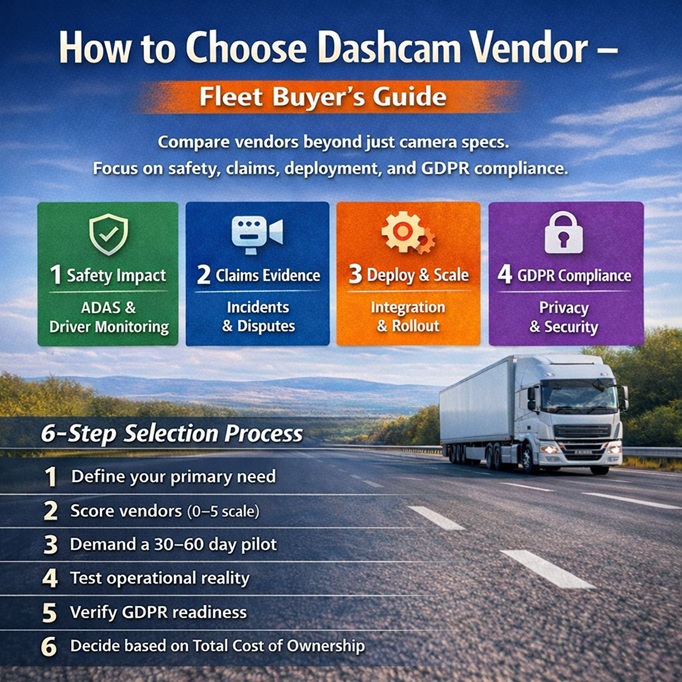
How to Choose a Dashcam Vendor
Selecting a dashcam vendor is no longer about “camera quality” alone. For commercial fleets, the right choice is the system that reduces risk, speeds up incident handling, scales operationally, and stands up to GDPR scrutiny.
At SafeFleetView we recommend evaluating vendors using a 4-block scorecard that forces objective comparison beyond price and marketing claims. This page summarises the approach and gives you a ready-to-use structure.
The 4 Blocks That Decide Real Outcomes
1.Safety Impact (Prevention + driver behaviour change)
This is where ROI is created. Prioritise features that actively reduce collisions and near-misses, not just record them.
What to check:
ADAS alerts: Forward Collision Warning (FCW), Pedestrian Collision Warning (PCW), Lane Departure Warning (LDW)
Risk behaviour detection: tailgating, harsh events triggers
Driver Monitoring (DMS/DSM): fatigue/distraction, phone use, seatbelt, driver absence
Real-time in-cab alerts: audible feedback that changes behaviour during the shift
Buyer tip: Ask vendors to show event definitions (exact trigger logic), not only demo videos.
2) Claims Evidence (Incident clarity + disputes + cost)
Claims ROI depends on whether footage is usable, complete, and tamper-resistant.
What to check
Evidence-grade video: front resolution, wide field-of-view for context
Multi-channel support: front + cabin + optional side/rear cameras
Event integrity: impact sensor, harsh driving triggers, protected event clips
Storage & redundancy: adequate retention, dual storage options where applicable
Security: encryption at rest, secure transfer, controlled exports
Efficiency: modern codecs (H.265) to reduce bandwidth and storage cost
3) Deploy & Scale (Operations + rollout cost)
Many projects fail due to rollout friction and support overhead.
What to check
Connectivity: built-in 4G/Wi-Fi (avoid extra gateways where possible)
Regional coverage: cellular bands suitable for your operating countries
Positioning robustness: GPS + Galileo/GLONASS support improves accuracy
Vehicle data integration: CAN/J1939 readiness (if you need telematics correlation)
I/O & peripherals: for triggers, panic button, door signals, etc.
Vehicle compatibility: 12/24V, temperature range, installation time per vehicle
Support model: who provides 1st-line support, RMA process, spares availability
4) GDPR Compliance (Privacy + security + legal operations)
A dashcam program is a personal data processing operation. You must be able to prove compliance—not just “claim” it.
What to check (evidence-based)
Encryption at rest on device storage
TLS security for transmission to cloud
Role-based access control (RBAC) + MFA options
Audit logs: who viewed/exported/deleted and when
Retention controls: auto-delete, event-based upload, minimisation settings
Privacy controls: cabin privacy mode, audio policy options
Redaction tools: face/plate masking for sharing with third parties
DSAR readiness: export/delete processes and SLAs
Data residency: EU hosting options and subprocessor transparency
Contract pack: DPA, breach terms, subprocessor list
Operational pack: DPIA triggers, driver notices, policies, signage
This is exactly why our comparison scorecard includes a dedicated GDPR block with “what you must be able to prove” for each criterion.
Practical 6-Step Vendor Selection Process
1.Define your top use case (pick one primary)
Safety reduction & coaching
Claims/insurance evidence
Compliance-first recording (event-based)
Multi-purpose (requires stronger ops maturity)
2.Run a paper evaluation using the 4-block scorecard
Score each criterion 0–5
Require evidence: datasheets, screenshots, policy samples, security docs
3.Demand a 30–60 day pilot with measurable KPIs
Baseline vs pilot comparison (events/1000 km, harsh events, near-miss types)
Coaching workflow: who reviews, how often, and what actions result
4.Test the operational reality
Installation time, update process, connectivity stability, support responsiveness
5.Stress-test GDPR operations
Retention settings, access logs, export workflow, DSAR scenario
6.Decide based on total cost of ownership (TCO), not unit price
Bandwidth/storage costs, support time, claims savings, admin workload, compliance risk
Vendor Red Flags (Common Failure Points)
“We support GDPR” without providing audit logs, retention controls, and DPA/subprocessor list
Continuous recording as default with unclear minimisation controls (risk escalator in EU)
No clear role separation (any admin can export/share)
No proven workflow for incident evidence (who can export, how it’s logged, how long it’s retained)
Pilot offered only as a “demo install” with no KPIs, no baseline, no coaching process
AI-Powered Video Telematics for Safer, Smarter Fleets. Boost safety, reduce costs, and meet EU GSR compliance
Contact us
sales@ecotelematics.com
sales@safefleetview.eu
Finland, Turku +358 405189190
© 2026. All rights reserved.
Latvia, Riga +371 29125630
Lithuania, Palanga +370 63392200
Estonia, Tartu +372 5398 0890