



Video Telematics Without Illusions
Fleet challenges and how technology really helps to solve them a practical summary — the most common challenges, what actually works, and how to choose a system that delivers real results rather than becoming just “another IT system in your fleet.”
AI-POWERED ANALYTICSAI-DRIVEN FATIGUEADASVIDEO TELEMATICS
11/4/20253 min read
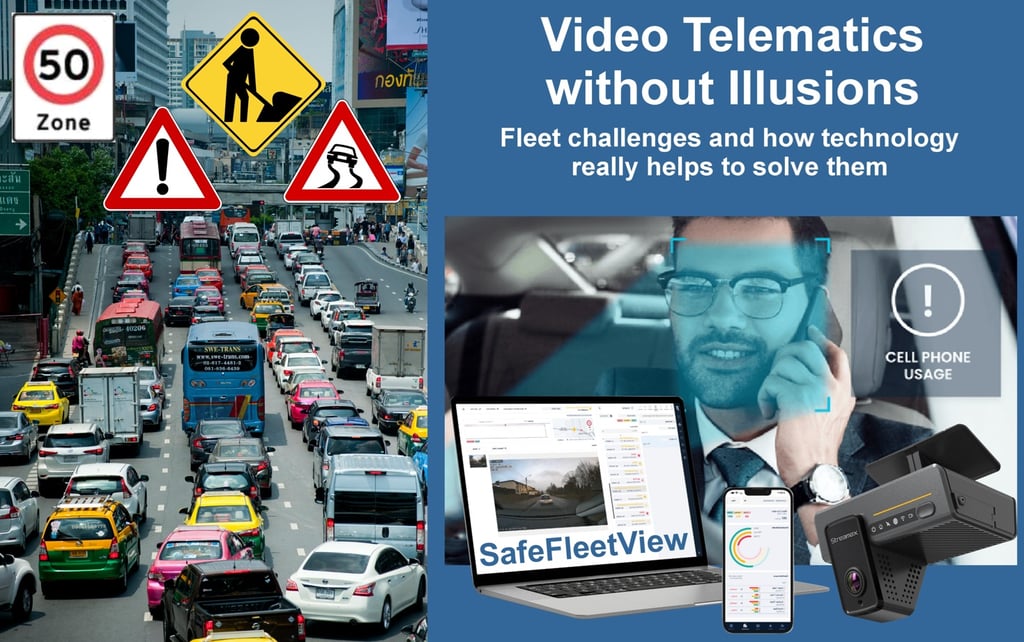
Over the past few years, we have launched and supported dozens of video telematics pilots. In some fleets, cameras became a foundation for safety and efficiency; in others, they turned into “another report that’s difficult to analyze.” Below is a practical summary — the most common challenges, what actually works, and how to choose a system that delivers real results rather than becoming just “another IT system in your fleet.”
Current fleet challenges
Disputed incidents and false claims. Time and money are lost resolving “word against word” situations.
Unstable driver behavior. Violations come in waves — seasonal stress, burnout, new routes.
Blind spots and urban maneuvers. Parking, turning, loading — many small accidents and near misses.
Data overload, low impact. Plenty of reports, but little actual change in driver habits.
Insurance and compliance. Evidence isn’t always available; storage policies and GDPR requirements are often unclear.
Integrations. Poor alignment with existing IT systems.
Traffic and storage costs. Unexpected expenses for video transfer and data hosting.
How technology helps (and where expectations are often too high)
Dual-facing cameras (road + cabin) provide context and close disputes — but only when clear access rules and event labeling are in place
AI-based in-cab alerts can really reduce risk if they are short, clear, and not overly sensitive (“false alarms every 30 seconds”). Threshold tuning and trigger quality are critical.
Multi-camera configurations cover blind spots in narrow streets, yards, and loading areas. Implement gradually — based on risk level and ROI.
Video evidence for insurance cases saves weeks — but only if the process is clear: who collects the episode, how it’s stored, and who can access it
Positive coaching changes behavior faster than punitive systems. Drivers accept technology more easily when they see a personal benefit
How to choose the right system — a short guide
Step 1. Define three key priorities.
Reliable evidence for insurance cases;
Reduction of minor city accidents;
Driver behavior training and onboarding.
Step 2. Match goals with system capabilities.
Disputes / insurance → dual-facing cameras + fast video export of recorded events.
Minor city accidents → multi-camera setup + triggers for distance, pedestrians, and clearance.
Behavior improvement → in-cab coaching + short post-shift review.
Step 3. Vendor checklist.
How do you control false alerts (phone use, distraction, objects in hand, etc.)?
Is there traffic sign recognition (speed limits, low bridges, restrictions)?
What is the video quality (at least 1080p, preferably 2K/4K)?
Is there onboard storage (minimum 128 GB) and how is it used when the connection drops?
How flexible is video access control (by role, by event, by time, by vehicle group)?
What integrations exist — ready APIs or connectors for your telematics or IT systems?
How transparent is maintenance and total cost — storage, cellular traffic, installation, spare parts, and SLA?
Step 4. Start with a mini pilot instead of a full rollout.
5–10 vehicles, 60–90 days, with predefined metrics and reporting format.
A pilot that actually proves value
Pilot group. Mix “quiet” and challenging routes, experienced and new drivers.
Before / after metrics.
Safety: incident frequency, speeding, seat belt use, phone distraction, following distance, attentiveness.
Behavior: share of “positive events,” driver response to alerts, progress dynamics.
Economy: time to resolve cases, number of disputed claims, confirmed savings or avoided payouts.
Operations: number of false alerts (per week per vehicle), traffic and storage usage, time to extract footage.
Process. Two–three threshold adjustments during the pilot + short weekly analytics.
Decision. Scale up only what shows clear effect on the most demanding routes.
Common mistakes — and how to avoid them
Too many cameras at once. Use only as many as the task requires; add more after the pilot.
Ignoring coaching. Without positive feedback and clear prompts, the system becomes just another report.
No policy for access and implementation. Conflicts are inevitable — rules must be defined early.
Underestimating maintenance costs. Traffic and storage can easily consume your savings — measure them during the pilot.
Vendor lock-in. Check for open APIs and export options — flexibility is a must.
Conclusion
Video telematics works when it solves real problems: proving driver innocence quickly, preventing risk in real time, and reinforcing safe habits. The key is not “AI magic,” but clear goals, careful calibration, transparent access policies, and short improvement cycles during the pilot.
How SafeFleetView can help
Define clear project goals.
Select the optimal system for your routes and operations.
Configure the pilot (metrics, access, coaching process).
Run 2–3 optimization cycles and demonstrate measurable results on your data.
For more information, please contact us
or let's create a Pilot Project
AI-Powered Video Telematics for Safer, Smarter Fleets. Boost safety, reduce costs, and meet EU GSR compliance
Contact us
sales@ecotelematics.com
sales@safefleetview.eu
Finland, Turku +358 405189190
© 2026. All rights reserved.
Latvia, Riga +371 29125630
Lithuania, Palanga +370 63392200
Estonia, Tartu +372 5398 0890